
















































By Kassia Garfield, MaxStrength Fitness
For decades, the conversation around health and longevity has focused heavily on cardiovascular fitness. We’ve been told to walk more, run more and keep our heart rate up. While cardiovascular health is certainly important, an increasing body of research is pointing to another powerful predictor of long-term health and survival: muscular strength.
Researchers across multiple fields — from gerontology to sports medicine — are finding that simple strength measures can predict not only physical function, but also disease risk, independence and even mortality.

One of the most widely studied markers is grip strength. It might seem surprising that something as simple as squeezing a hand dynamometer could tell us much about our health, but large-scale research suggests otherwise. In the massive international PURE Study, which followed more than 140,000 people across 17 countries, researchers discovered that grip strength was strongly associated with health outcomes. For every 11-pound decrease in grip strength, participants experienced a 16% increase in all-cause mortality and a 17% increase in cardiovascular death. Grip strength even proved to be a stronger predictor of mortality than systolic blood pressure.
Another key area researchers frequently examine is quadriceps strength. The quadriceps muscles play a central role in many basic functional movements — standing up from a chair, climbing stairs, maintaining balance and walking. Weakness in these muscles is strongly linked to loss of independence, higher fall risk and increased hospitalization rates in older adults.
Quadriceps weakness is also a hallmark of sarcopenia, the progressive decline in muscle mass and strength that occurs with aging. Sarcopenia significantly increases the risk of frailty, disability and reduced quality of life.
What’s particularly interesting is that researchers are discovering that strength may be even more important than muscle size. While muscle mass has long been studied as a marker of health, strength appears to correlate more strongly with functional outcomes. In other words, it’s not just how much muscle someone has — it’s how much force they can produce with it. This is evident on body scans showing high muscle mass percentages, yet some individuals cannot stand up from a chair without using their hands.
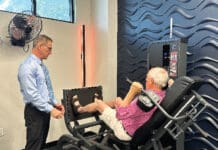
This is why modern clinical assessments increasingly use functional strength tests rather than just body composition measurements. Simple assessments such as grip strength, sit-to-stand tests, walking speed and leg press strength are now commonly used to evaluate aging and physical resilience.
These tests may look different, but they all measure the same underlying quality: the body’s ability to produce force.
The reason this matters is because muscle strength naturally declines with age. Most people reach peak strength in their 30s. After that, strength typically declines about 5% per decade through the 40s and 50s. After age 60, that decline can accelerate to 10–15% per decade if no resistance training is performed.
By the time someone reaches their 70s, they may have lost 30–40% of their strength compared to their younger years.
Fortunately, research consistently shows that strength is highly trainable — even later in life. Resistance training can dramatically improve strength, balance, mobility and metabolic health in adults well into their 70s, 80s and beyond.
When people look at studies on longevity, they often focus on the specific markers being measured: grip strength, quadriceps strength, walking speed or chair-rise performance. But the reality is that these are simply different ways of observing the same underlying factor.
The bigger story is not grip strength alone. It’s not just quadriceps strength either.
The real marker is strength itself.
When researchers study these different measurements, they are all essentially examining the same fundamental quality: how strong the human body is.
Strength reflects the health of the neuromuscular system, the integrity of muscles and bones, metabolic function and the ability to perform the movements that keep us independent. It influences how we move, how we work and how resilient our bodies are as we age.
In many ways, strength acts as a summary measure of overall physical health.
So, while the headlines might highlight grip strength or leg strength, the broader message is much simpler: maintaining strength throughout life is one of the most powerful things we can do to support long-term health, independence and longevity.
If you are having a hard time fitting in a workout, try MaxStrength Fitness. We offer effective, efficient and safe 20-minute workouts just twice a week. Our science-backed program delivers real results. Give us a call at 850-373-4450 (Niceville) or 850-467-9729 (Fort Walton Beach).