Home Blog Page 89

5 Ways to Resolve Your Insurance Claim: Part 1

By Matthew Vanderford, Claimology

Knowing how to resolve an insurance claim dispute can become tiring, even for the most experienced professionals in the Insurance Claims Handling Industry. Many people file claims on their own and are met with many different reasons WHY their insurance companies are not providing coverage, or even working with them to resolve issues when coverage is afforded early. There are several ways to handle issues like this: Continued direct negotiations with carrier adjusters, mediation, appraisal, legal action or doing nothing at all.

Today we’ll talk about Appraisal. Appraisal is an Alternative Dispute Resolution that has been used for over 100 years to resolve insurance claims issues. The process is similar to arbitration allowing for a three-party panel to come together to set the amount of the loss. Once the amount is set, the insurance companies are bound to pay the amounts awarded as provided through coverage. Below is a sample of some appraisal language that is found in most polices. Every policy differs in content. So, make sure to check if your policy contains this provision. You can even contact your insurance agent to see if your insurance policy contains this type of resolution process or what, if any variation exists. You might even want to think about a different policy that does contain this type of resolution.

Appraisal. If you and we fail to agree on the actual cash value, amount of loss, or cost of repair or replacement, either can make a written demand for appraisal. Each will then select a competent, independent, impartial appraiser and notify the other of the appraiser’s identity within 20 days of receipt of the written demand. The two appraisers will choose an umpire. If they cannot agree upon an umpire within 15 days, you or we may request that the choice be made by a judge of a district court of a judicial district where the loss occurred. The two appraisers will then set the amount of loss, stating separately the actual cash value and loss to each item. If the appraisers do not agree, they will submit their statements to the umpire. Agreement by the umpire and either of the appraisers will be binding. Each party will pay its own appraiser and bear the other expenses of the appraisal and umpire equally. Even though we may submit to an appraisal, we will retain our right to deny the claim.

Appraisal offers certain benefits in comparison to litigation. For example, most policies require that appraisers be competent and disinterested, meaning that they are well versed in the areas of dispute and are not compensated directly from the outcome of the appraisal itself. Another benefit is that appraisal in intended to keep claims from clogging up the courts system while offering a real conclusion to the claim. As litigation can take years in some cases to finalize a loss, appraisal is meant to fast track the settlement process, usually resolving the dispute within 90 days.

Knowing when to invoke or accept this process is also especially important as not every claim is “ripe” for appraisal. Because there are many factors to consider involving issues with coverage and damages, it’s prudent to contact someone who can advise you (such as a public adjuster or attorney) if appraisal is the best option, when it should be used, or if the carrier has demanded the process forward and you need help to resolve the dispute.

“The Pessimist Sees Difficulty In Every Opportunity. The Optimist Sees Opportunity In Every Difficulty.”
– Winston Churchill

Key Numbers We Are Watching

Maurice StouseBy Maurice Stouse, Financial Advisor and Branch Manager

While the economy rebounds and fears of inflation abound, we continue to watch those indicators we believe will help us and our clients make well informed decisions as to the direction and allocation of their investments. We do not try to predict markets, but rather strive to be ready vs. trying to be right. With that in mind here are some key data that we track daily as we monitor and help our clients manage their portfolios:

Earnings: These are some of the strongest earnings U.S. companies have seen in almost 40 years. To put that in contrast, in 2019 the earnings of the S&P 500 was $162. In 2020, during the middle of the pandemic, that shrank to $142. Look at 2021: Current run rates are $200. Fidelity Investments, in a recent investment professional webinar shared those S&P earnings for 2021 might even hit $225.

Stock prices are mostly based upon earnings. This might help explain the return of the market year to date and over the past year.

Free Cash Flow: That is money that a company has left after paying its bills, debts, its dividends, and other things. Free Cash Flow for many sectors (Energy in particular) is reaching significant highs.

Market Corrections: Corrections occur in the stock market, the bond market, the real estate market, and the commodity markets. We are aware and want our clients to be reminded that this can always be a possibility. One such risk is on the rise: Should the Fed wish to start tightening by decreasing its monthly asset purchases of over $120 billion dollars. That is what has been called tapering and, in the past, the markets have experienced the so called “taper tantrum” where most asset classes experienced a sell off when the Fed makes shifts like this.

Inflation: Like many advisors, we watch these number closely. We have some specifics to share with you beyond the stated CPI and PPI numbers. CPI, the Consumer Price Index, was reported this past Thursday for the month of May. It showed the year over year inflation rate at 5%. PPI (the Producers Price Index) was reported this past week and came in at 6.60% – May 2020 to May 2021. Both numbers show inflation potentially running at twice of what is known as “The Expected Inflation Rate.” That rate is the rate at which most institutional investors expect as the actual long-term rate of inflation. That number is available daily. However, it needs to be computed by looking at two factors: a) the U.S. Treasury 10-year note yield and b) the U.S. Treasury 10-Year Inflation Protected Notes Spread. The difference between the two is the expected inflation rate. That is the result of the pricing that the market puts on those Treasuries based upon what they think the inflation figure really is.

Note: The Federal Reserve more closely watches the movement in an index called the Personal Consumption Expenditures (PCE) index according to Fidelity Institutional, in its June 2021 report on Fixed Income. The PCE is published by the U.S. Department of Commerce. That next reading will be June 25. For now, that number is 3.1% for April which increased substantially from March when it stood at 1.9%.

At this writing, the 10-year U.S. Treasury was yielding 1.45% and the U.S. Treasury 10-Year TIP Spread was -.985%. So, the difference between the two is 2.435%. That is the rate the markets expect the true rate of inflation to be. That is obviously off the stated rate of the CPI and even the PCE. Why might this be so?

Many economists, investors and the Federal Reserve think the current CPI and perhaps the PCE are transitory in nature – the result of the economy rebounding from the lows realized just one year ago in the middle of the pandemic. They also point out that the CPI numbers are distorted by just a few things: Used cars, airline prices, gasoline and food. Add to that the numerous gaps in supply as a lot of manufacturing capacity had been reduced or shuddered during the pandemic.

“2.35%. That is the rate the markets expect the true rate of inflation to be.”

As a result, the markets have shrugged off the potentially ominous CPI numbers believing that the real inflation picture is the expected rate. The market is signaling that there are not too many dollars chasing too few goods which is the classic definition of inflation. We are in a different spot from this. We think that monetary inflation – the growth of the money supply as having much greater impact than temporary supply gaps.

There are several things to consider: 1) The Federal Reserve’s balance sheet sits at $7.95 trillion dollars. That is up from $4.16 trillion dollars at the start of the pandemic. The balance sheet was $2.2 trillion dollars in November of 2008 during the Great Recession. Just two months before that it was at $925 billion dollars. In other words, the Fed’s balance sheet has almost doubled in the past year and is up tenfold since just prior to the Great Recession. The balance sheet is simply the amount of money the Federal Reserve has injected into the financial system by way of buying bonds on the open market When they buy bonds, they use newly produced U.S. dollars to buy those, thus increasing the supply of money. That means a tremendous amount of liquidity. It is liquidity that supports and raises the prices of assets be they stocks, bonds, real estate, or the cost of borrowing and so on. 2) Federal deficit spending. We are approaching a record deficit of $4 trillion dollars. The U.S. government has added to supporting the economy by way of its own spending on stimulus and other programs. That means even more money into the system. 3) Labor shortages – as the economy continues to emerge and grow the number of job openings has caught up with the number of unemployed workers yet employers across the country from restaurants to construction cannot hire the labor to meet the increase in demand. 4) according to Fidelity Institutional, liquid savings are now at $4 trillion dollars, up substantially. Also, the U.S. savings rate is over 14.1% according to Tradingeconomics.com and it remains high (it was less than 10% at the start of the pandemic). You might see that as a lot of money on the sidelines, which is waiting to be spent on dining out, traveling, vacations, leisure and other things as the economy reopens.

Liquidity is the opposite of constrained credit. During the Great Depression, and what brought about the Great Recession can in part be blamed on the lack of liquidity and the lack of credit. That makes demand go off the proverbial cliff, prices deflate, and a recession or depression ensues. Many market pundits think once the supply imbalances are worked through that we will return to continued deflation. Their reasoning is not because of a lack of credit or liquidity but rather due to technology and a shrinking population. They think this time it is different. We do not agree.

The demand for housing has been unprecedented. This is more a result of the liquidity that is out there versus demand, in our opinion. If the Fed balance sheet had not doubled or the deficit spending not occurring, housing and other asset prices would not be supported at current levels. We think the only thing that will cause the housing market to cool, or even slowdown will be the reduction in Federal Reserve monetary injections.

So, what are the takeaways for clients? First, to review strategies and allocations and look to see if you have the diversification, you need or want should you be of the same belief that monetary inflation will indeed impact the expected inflation rate. There are several strategies to consider where inflation resilient or inflation resistant investment are concerned. Equity (stock) investments in Energy, Financials, Materials, Industrials, Commodities and Real Estate. Investments into small and medium sized companies (or funds that invest into those) is advisable as well. Investing in emerging and developed foreign stocks (or funds) for a portion of your allocation as well.

Second, review fixed income holdings. For those that have investment grade corporate or long-term maturities? You may consider adding short term inflation protected bonds, like TIPS to your portfolio.

Third, consider the real rate of return on your investments. That is the return you are getting less a) the expected inflation rate and b) the nominal (stated) inflation rate. As an example, if you have a bond paying 3%, its real return would be .565% after the expected rate of inflation or -2% with the nominal or stated rate of inflation. The same can be said for stocks, or growth investments and real estate. Look at your return and subtract out both inflation rates and make any needed adjustments accordingly.

When managing your investments and financial affairs we encourage investors to review and think about what changes they need or want and then to make those over time, not necessarily overnight. At The First Wealth Management and Raymond James, our focus is on actively monitoring and over actively managing our clients’ investments. We appreciate the old saying that at first you concentrate to build wealth and then you diversify to preserve it.

The First Wealth Management is located at First Florida Bank, a division of the First, A National Banking Association, 2000 98 Palms Blvd, Destin, Fla. 32541 with branch offices in Niceville, Mary Esther, Miramar Beach, Freeport and Panama City. Phone 850.654.8124.
Raymond James advisors do not offer tax advice. Please see your tax professionals. Email: Maurice.stouse@raymondjames.com. Securities offered through Raymond James Financial Services, Inc. Member FINRA/SIPC, and are not insured by bank insurance, the FDIC, or any other government agency, are not deposits or obligations of the bank, are not guaranteed by the bank, and are subject to risks, including the possible loss of principal. Investment Advisory Services are offered through Raymond James Financial Services Advisors, Inc.

The First Wealth Management First Florida Bank, and The First, A National Banking Association are not registered broker/dealers and are independent of Raymond James Financial Services.

Views expressed are the current opinion of the author, not necessarily those of RJFS or Raymond James, and are subject to change without notice. Information provided is general in nature and is not a complete statement of all information necessary for making an investment decision and is not a recommendation or a solicitation to buy or sell any security. Past performance is not indicative of future results.

Investing involves risk and you may incur a profit or loss regardless of strategy selected, including diversification and asset allocation. Investors should consult their investment professional prior to making an investment decision.

Investing within specific sectors, or in small and mid-size companies, involves unique, additional risks. Those risks include limited diversification, regulatory risks, limited liquidity, and lack of operating history.

There is an inverse relationship between interest rate movements and fixed income prices. Generally, when interest rates rise, fixed income prices fall and when interest rates fall, fixed income prices rise.

Investors should carefully consider the investment objectives, risks, charges, and expenses of mutual funds before investing. The prospectus and summary prospectus contains this and other information about mutual funds. The prospectus and summary prospectus is available from your financial advisor and should be read carefully before investing.

My Rental Property Insurance Program: Coverage Checklist

By Joe Capers

Our beautiful areas of NW Florida are popular destination for vacation home renters. And we must be alert to the fact that standard homeowners and condo insurance policies are designed to cover only owner-occupied or secondarily occupied properties with no rental exposure. The intention is not to cover a home that is rented out to guests. Many insurance companies will not even knowingly provide a policy for short term rental insurance in Florida. So, beware when placing coverage for your rental exposure.

You might be under the impression that Homeowners Insurance and landlord/tenant (rental property) insurance are the same. There are similarities. The Homeowner form is usually broader and is used if the occupancy is primary or a secondary residence. The Dwelling Fire form is more limited and is usually required when the home has rental exposure.
Regardless of the form, you want the correct amount of coverage to rebuild the primary dwelling and other structures on the property, along with hurricane and wind protection.
Insurance industry statistics shows that two out of three homes are underinsured. Other essential areas of coverage include replacement cost on the contents, loss of rents, loss assessments, liability, rebuild to code (Ordinance or Law), increased mold and much more.

You might also think there’s no difference in coverage or carriers depending on whether you rent your place out annually, for a week or for a few nights. But there you’d be wrong.

“What will be the shortest length of time you’ll offer your place for rent?” The answer to this question is crucial in making sure you have the correct policy. Some carriers allow only annual leases, some a minimum of one-week rental and a few others allow less than seven nights. You might be wondering why it’s all that important. In the world of insurance, all information should be as accurate as possible, so a carrier won’t have a ready excuse to deny a claim.

For short-term rentals, since they come fully furnished, make sure you have enough contents coverage to replace the furniture, dishes, linens, accessories, electronics, decorations, etc. in the event of a loss. Replacement cost is always recommended over actual cash value, since actual cash value depreciates the items for age and wear and tear.
There’s also the added liability exposure with rentals which tends to be most costly as well.
If your weekend getaway renter trips over a rug, falls down the stairs and breaks his leg, you need to be ready for a possible lawsuit. Most rental property policies offer liability coverage options between $300,000 and $500,000. Depending on the amount of assets you need to protect, it might be beneficial to purchase a separate Excess Liability policy with coverage limits starting at $1 million or more for your rental property. If the property is titled to you individually and you have a personal Umbrella policy in place, you might be able to add your rental property to that policy. One caveat – if your rental property is titled in an LLC, partnership or other entity instead of your personal name, you’ll probably be unable to add it to your personal Umbrella. Excess liability policies are an affordable way to obtain extra asset protection.

And, of course, you don’t want to forget about flood insurance. It’s as important to have a flood policy on your primary residence as it is on your rental properties, and one should consider purchasing limits to the full replacement cost of the dwelling and contents.
When it comes to short-term rental insurance, always speak with an insurance professional, and make sure you have the coverages you need to make your rental experience a successful one. It is imperative that you select a good carrier that offers short term Renters insurance for your rental properties or temporary vacation rentals. As we demonstrated, these policies protect you from damages that occur when someone else permanently or temporarily rents space in your home.

Insurance Zone, founded by Joe and Lea Capers, is a full service commercial and personal lines insurance agency serving Destin, Miramar Beach, Santa Rosa Beach (30A), Niceville, Freeport and Inlet Beach. Visit their Video Library on www.ins-zone.com and watch several informative videos on ‘Homeowners, Condo Unit Owners and Flood,’or call (850) 424-6979 and talk with one of our experienced Team Members.

Transitioning Out of The Military? Now Is Time for The Job Search

By William Blanken

The transition from the military to a civilian job can be difficult. Fortunately, you can follow a few key steps to make the process as smooth as possible and help find a job that is financially and professionally rewarding.

At the beginning of your search, you will want to reach out to your local Transition Assistance Office to locate resources that can help you with your job search, which includes a mandatory five-day workshop tailored to assist you with every step of the job search, from writing resumes to understanding veterans’ benefits. For more information, visit the U.S. Department of Labor website at www.dol.gov/vets.

When time for discharge, you will be receiving an over abundant amount of paperwork. That pile of paper will contain items and documents much needed for resume building. You will also want to have many copies of your DD214. In addition to hard copies, have a digital copy in a transition file.

Next, consider whether you will need additional education and training. For instance, will you apply for jobs that require a two- or four-year degree? Do you need a license or certification to work in a particular field? When you choose which path you’ll take, be sure to investigate whether there are veterans’ benefits available to help pay for further education. If you would rather match the skills you gained from your time in the military to a civilian job, get started with an online search. One example of a website that caters directly to military members looking for civilian employment is USA Jobs at www.usajobs.gov.


You will also want to make sure that your finances are in good shape during the transition process. This means creating or building an emergency fund you can tap into in case the job search takes longer than anticipated. In the meantime, you might consider temporary employment to provide a source of income. Think carefully about the pay and benefits associated with a job before you accept an offer. That way, you’ll know whether it suits the needs of both you and your family.

Important note when being discharged: Please ask many questions about benefits that you are entitled to. There are numerous benefits available to military and veterans. So, it is advantageous you ask how they can work for you.

Along the way, make sure to protect your personal information. Because members of the military are major targets for identity theft, avoid any job sites that seem questionable. Looking for civilian employment is stressful enough without having to worry about financial fraud.

Off the Hook: Tarpon Run in Destin!

By Cali Hvalac, Silver Shade Studio

The Tarpon have arrived! A bucket list fish for many anglers, Tarpon are most commonly found in South Florida, but Destin sees a passing migration during June and July. Tarpon are known for their massive size, can reach up to 8 ft. long and weigh 280 lbs. They also have an extremely long lifespan, averaging approximately 50 years with the oldest being estimated at 63 years. Their majestic appearance garnered them the nickname “The Silver King” and the reputation as one of Florida’s most premier game fish.

One of the most intelligent fish, Tarpon are a prehistoric fish that have been dated back as far as 100 million years. They have no teeth, just a sandpaper like surface inside their mouths and they swallow their bait whole. Their scales are shiny and appear silver in color, and anglers will often take one scale as a prize for their catch.

Most people are surprised to see them swimming near shore, by the beaches in large schools. Often, you’ll see them “rolling” on top of the water, while they feed and they are one of the only fish to break the surface to gulp breaths of air. Being able to breathe outside of the water is partly why they can fight for so long while being hooked up. Anglers will experience fights with Tarpon that can last 2-3 hours, wearing the fish down before trying to get him to the boat.

Tarpon, or the Silver King, are considered a once in a lifetime catch. Once hooked up, these fighting fish will jump and shake in the air, trying to loosen the hook and break free. There is a technique to catching them and being able to get them to the boat is a huge victory. Anglers cannot remove Tarpon from the water, and most will get in the water with the fish to take their photo. Per the FWC, these fish are protected and are catch-and-release only.

With our beautiful Destin already being a huge fishery, Tarpon adds even more to the area. Anglers can now target this bucket list fish during summer months on a boat, kayak or fishing pier and have a shot at the beautiful creatures. If you want the best shot at catching one, hire a guide who has perfected the catch, since these bucket list fish are one of the hardest to get to your boat. Destin has a variety of talented fishing guides who can assist you with these majestic creatures to cross them off your bucket list!

Local Resident Shares Passion for Beach Safety!

By Rita L. Sherwood

Calling all locals!! We need your help!! How many times have you been at the beach and you’ve seen a visitor, whether it’s a parent or a child, go in the water on a double red flag? The reality is, despite the colorful flags being flown at the beach, not everyone really knows the meaning. How many lives could be saved if we just educated them a little bit better?

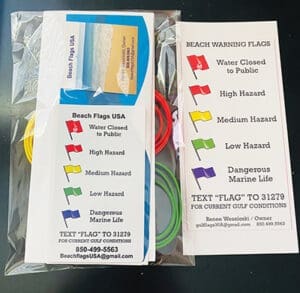
Renee Weslowski is trying to do just that through her colorful wristbands from Beach Flags U.S.A. Renee’s passion is to make learning about beach flags colors and their meanings fun, while also keeping everyone safe while enjoying the beach.

Beach hazards can encompass everything from large waves to strong currents, rip tides, and even marine animals like sharks. These beach hazards can be more dangerous than we think. Renee created these colorful wristbands through the States Lifesaving Association in collaboration with the International Lifesaving Federation. Her hope is that every visitor receives a colorful wristband according to the flags flown at the beach. Put it on, adults and kids alike, then they know what to do according to the color.

Renee has been beating the pavement and trying to get the wristbands placed in every rental house, condo, and hotel room here in our area. Do you own a second home or a condo here? For a nominal fee, you can do your part to educate kids and adults alike. The kids can even take the wristband home as a souvenir. The goal here is to empower parents to educate their kids, families, and friends.

And what do the different colors of flags and wristbands mean?

Red over Red /or Two Red flags is CLOSED. It indicates extremely dangerous conditions such as high surf, strong rip tide currents, sharks, excessive jellyfish etc. YOU CAN NOT enter the water, and if you do, you are subject to a $500 fine.

Red flag is HIGH HAZARD. Again, it indicates extremely dangerous conditions such as high surf, strong rip tide currents, etc. YOU CAN NOT enter the water.

Yellow flag is MEDIUM HAZARD. A yellow flag means that the surf conditions are moderate and rip currents are present. A yellow flag is a sign to exercise caution.

Green flag is LOW HAZARD. A green flag means that hazardous conditions are lower than normal, although the Gulf can be unpredictable. You can think of a green flag as all clear, and it’s safe.

Purple flag is MARINE LIFE IS PRESENT. Stingrays, jellyfish, sea snakes, and other types of marine animals are present.

Renee says, “The most rewarding part of this passion project of mine is giving back to our local community. Just think if these wristbands saved even one person from drowning, it’d be worth it!” Considering the four million tourists who will travel to our three counties this summer, I bet it’d save more people than that!

Renee is no stranger to giving back, as this widowed mom of three boys (now young men) used to be a hairdresser who worked with the American Cancer Society (ACS) helping women who lost their hair. She had a certified wig bank and would help women cut and style their wigs for a program called “Look Good Feel Better” with the ACS.

To find out more about her passion project, the beach safety wristbands, contact Renee at BeachflagsUSA@gmail.com or call 850-499-5563 or 216-336-0236.

And if you need any painting done, Renee and her fiancé also own All Around Painting 30A LLC, and they can be reached at 850-278-6405, or check them out on Facebook.

Meet our Hero: Terry Wadsworth Warne

Life in a WWII Prison Camp

By Kenneth Books

Some who have endured life in a wartime prison camp carry the scars with them for the rest of their lives. Terry Wadsworth Warne took a different route. She wrote a book—Terry: The Inspiring Story of a Little Girl’s Survival as a POW During WWII.

In it, Terry tells of her three years as a prisoner of the Japanese in the Philippines during World War II. She was just 8 years old when she and her parents were captured and imprisoned.

“We encouraged her to write the book,” says her daughter, Sally Reynolds, a local resident.
For years, Terry had presented talks to schools and groups about her experiences. She said those talks “are the backbone of the book.”

Written in a breezy style that draws the reader into the story, Terry tells of the sometimes harrowing, sometimes heartwarming, events of her daily life under the watchful eyes of the Japanese. “I didn’t want people to feel sorry that we were in the prison camp,” she said. “I just wanted people to hear the story.”

Although the prisoners were not tortured, as was the case with many military prisoners of war, they endured deprivation and starvation. Terry weighed 60 pounds when she was first imprisoned. By the time she and her family were rescued by the U.S. Army, she had lost 20 pounds and had not grown an inch in three years. Frequently, their diet consisted of a watery rice, often with insects in it, and various weeds they could find or cultivate. The deprivation had effects on some of the prisoners for the rest of their lives. “Sally’s grandfather (Terry’s father, Norris Wadsworth) was almost blind,” says Gary Reynolds, Sally’s husband, a retired Air Force lieutenant colonel.

But the family survived and witnessed a number of miracles. At one point, several American leaders of the camp were taken out and beheaded. Norris Wads-worth was too sick to go. And when the Americans arrived to free the prisoners, they didn’t know which way to go to find the Japanese. Beside a tank, a man cried out, “Give me light.” The soldier in the tank shined a light toward the voice and saw a bearded man in a robe, carrying a staff. He pointed the staff and the soldiers found the men they sought.

Crucial to the telling of Terry’s story were diaries she, her mother, her father and fellow prisoner Helen Brooks kept. The words written within those books prompted memories and allowed Terry to create a book rich in detail.

Terry and her family lived in the Philippines while her father worked at the Del Monte plantation. When the Japanese invaded the country, they were told they would be flown out to Australia. But every plane that had been sent quickly filled up, leaving the family to fend for themselves. Terry and her family found themselves with only one option. Surrender! As they surrendered to the Japanese, Terry’s father counseled her, “Live each day to the best of your ability. Do not get caught up looking so far ahead that, worrying about the future, you get discouraged and lose hope.” The advice served her well, as the next three years of her interment as a prisoner of war were full of hardship and suffering. Though stripped of her possessions and freedom, Terry was grateful to be alive and to be with her parents.

Terry felt no animosity toward the Japanese in spite of her ordeal. “If you carry hate with you, it can destroy you,” Terry said. Her son-in-law agrees. “Sally’s mother was probably one of the most positive, optimistic, outgoing people I ever met,” Gary says.

Despite being imprisoned, Terry’s education continued, although it was sometimes halted because of bombings and shellings. A Catholic priest served as the main teacher, although he had no actual teaching experience. But his teaching was so skilled that Terry skipped two grades when she returned to the States. “They didn’t have anything,” Sally says. “But they taught the kids.”

Because of the shared ordeal, most differences among the prisoners were forgotten.
“I asked my mom what about church,” Sally says. “She thought about a third of the prisoners were missionaries, but they all worked together. They prayed for each other and combined their faiths together.” Terry’s unconquerable spirit, as an eight-to-11-year-old prisoner of war, is a reminder that even in the most deplorable circumstances, life is what you make of it.

Terry peacefully returned home in 2018. Terry was a ray of sunshine in the lives of everyone who knew her.  She was dearly loved and is sorely missed by her family and all those who have been fortunate to be her friends.

Terry: The Inspiring Story of a Little Girl’s Survival as a POW During WWII can be found on Amazon.com.

Bay Life’s “Hometown Heroes” are sponsored by Northwest Florida State College. To read about more Hometown Hero graduates or for more information, call 850.837.8880 or visit nwfsc.edu.

Buyer, Be-AWARE! Are You In the Loop?

Gail PeltoBy Gail Pelto

There’s a whole lotta stuff you need to know before you jump into the home buying process—a BUNCH of “do’s and don’ts.” One of those is how to go about getting financing for a mortgage, how to choose a lender, and the best practices on communication with your lender.

If you’re financing (and why wouldn’t you with interest rates so low?!?!), a really important thing to know is how to choose a lender. If you get a lender who tells you, “Yah, yah, we can get you a 2.5% interest rate” WITHOUT asking you a lot of critical questions about your needs, wants, desires and ability to get a loan, DON’T WALK AWAY—’RUN FOREST, RUN!’

My friend, and preferred lender, Bonnie Manthey with Inlanta Mortgage, is my “go-to” when I have questions about lending. Her brain is chock full of great information and she asks a ton of questions to potential clients before she gives them the information they need to get the best mortgage rate. Once she retains you as a client, she also gives you a list of Ten Commandments of what NOT to do while you’re going through the process of securing your loan in order to buy or refinance a home:

1. Thou shall NOT change jobs or become self-employed.
2. Thou shall NOT originate any new inquiries on your credit report or take out any new credit.
3. Thou shall NOT buy a car, truck or van.
4. Thou shall NOT use your credit card to pay off debt other than scheduled payments or fall behind in your payments.
5. Thou shall NOT spend the money you have saved for your down payment, get a gift for closing, or take out a retirement loan without first consulting with your loan officer.
6. Thou shall NOT buy furniture before you buy your house.
7. Thou shall NOT make any large deposits into your bank account or shuffle money around unless you plan on documenting that deposit or origin of the money, i.e. anything that is not payroll related.
8. Thou shall NOT change banks or bank accounts.
9. Thou shall NOT co-sign for anyone.
10. Thou shall NOT make ANY large purchases until after closing!

Those are BIG “Don’ts,” but great information. In last month’s article, I talked about how to get an offer accepted in this seller’s market; one of the things that can help you is to get pre-approved by your lender—not pre-qualified—there is a difference. You can get a pre-qualification online in a matter of minutes, because it is based solely on your credit score. Pre-approval goes a bit further; the lender has done more work to see if they can, in fact, give you money. It takes a few more days. However, it holds more weight when submitting an offer and gives you more certainty as a buyer. After all, this might be one of the largest financial and, yes, emotional investments you may ever make.

Three things to consider when consulting with your lender: 1. Make sure they’re asking YOU a lot of questions. 2. Ask them once you’re pre-approved, what is their professional recommendation on the best time to lock in your interest rate? 3. Ask what their process is for keeping you, your real estate advisor (maybe ME!), the title company, and the seller’s agent in the loop?

A final thought on the importance of communication. As a client’s listing agent, I had a transaction fall apart because of a non-responsive lender. He wouldn’t return calls or emails and didn’t keep me or the buyer’s agent in the loop. The result? The deal fell apart, the buyers lost their deposit and the seller had to find a new buyer! And in my opinion? He was bad for everyone! ALL could have been avoided had the lender simply kept us in the loop.

Now? Along with my communication standards backed up by Bonnie and her crew that are great at letting folks know about where the buyer’s file is in the process, we know if we are going to close on time. The better result? Buyer Happy…Seller Happy and THAT’S the goal now, isn’t it?

Whoever you choose as your lender and advisors, print out the above 10 Commandments and ask them, “Should we follow this list?” I pray their answer is, “Of course!”

I’m here to help whether you’re looking to buy, sell or invest now or in the near future or if you just have questions about what’s going on in this crazy real estate market—850-374-0454 or Gail.Pelto@KW.com.

Locally-Owned Islanders Coastal Outfitters Partners with CBA for Healthy Local Waterways

The Choctawhatchee watershed and its abundant waterways inspire a water-based lifestyle that is the heart of the local culture and economy. Islanders Coastal Outfitters and Choctawhatchee Basin Alliance (CBA—hometown organizations focused on local waters—recognize this and have joined together in the “1% for the Planet” network to help take care of our corner of the planet.

In 2002, the founders of outdoor lifestyle brand Patagonia and nonprofit Blue Ribbon Flies created the model for 1% for the Planet, where businesses give 1% of sales back to the environment by partnering with nonprofits. 1% for the Planet now represents a global network of businesses, individuals, and nonprofit organizations tackling the planet’s most pressing environmental issues.

A new member of 1% for the Planet, Islanders Coastal Outfitters was established in 1980 and has since flourished as a well-known local beach and outdoors shop. Catering to “the beach and watermen culture,” Islanders pledged 1% of sales to help support CBA’s efforts to promote healthy local waterways. Founder John Hambleton explains:

“Our leadership team at Islanders bought into partnering with the CBA as a worthwhile and impactful way to give back to our community. We believe with the growth of our area we have to work to maintain – and ideally to restore -these core quality of life resources that we should not take for granted: our bay, our bayous and our beaches. This will be a challenge but we like challenges and we want to pass on to future generations healthy waterways so they too can fish and swim and surf as our generation has enjoyed.”

CBA’s mission is to sustain swimmable, fishable, livable waterways through education, restoration, monitoring and research. CBA provides education and experiences that empower people to do their parts to take care of our community and our environment. CBA’s 1% for the Planet partnership with Islanders Coastal Outfitters centers on CBA’s stewardship programs located in the Fort Walton Beach and Okaloosa Island communities. The first project of the partnership will combine CBA’s K-12 environmental education and oyster shell recycling programs to source materials for a living shoreline at Liza Jackson Park.

“We are so excited about this partnership with Islanders,” says CBA Director Alison McDowell. “It’s a perfect example of the type of personal responsibility and environmental stewardship CBA hopes to inspire and facilitate. We look forward to working with our friends at Islanders to restore and conserve local waterways.”

To learn more please visit: basinalliance.org, onepercentfortheplanet.org or islandersoutfitter.com.

The Importance of the Walk

By Melanie Barrett

“I have a big yard, so I don’t need to walk my dog.”

“My dog likes to play fetch so I throw the ball for a while and that’s how he gets his exercise.”

This is what I hear from a lot of dog owners—not just my clients. There is so much more to the dog walk than just taking them out to go potty. The pack walk between you and your dog(s) is the most natural thing you can do with your dog. It can empower you as their leader and make you relevant in their eyes. When that is the case, your dog will look to you for direction. Being a leader and protector is critical to having a healthy bond with your dog. Walks are a healthy way to bond with your dog and therefore boost your bond as a leader-follower team.

Many unwanted behaviors can be solved on the pack walk. With practice, patience and commitment to the process, you can stop leash aggression, pulling, jumping and biting the leash, to name a few behavior problems.

While out walking, your dog will most likely meet other dogs. This is a great opportunity to help your dog learn acceptable ways of socially interacting with new dogs. It can help build confidence in your dog being around other dogs. Walking your dog around other dogs, people and environments is a win-win situation. Before I had a pack of five dogs, the three I had were no fun to walk. I think they thought they were sled dogs because they were pulling so badly. After I trained with Cesar the Dog Whisperer for the first time in 2016, I learned specific walking rules that actually changed the way I walked my dogs.

Now my pack and any other dogs that may be in my care, have pleasant walks. There is no pulling, no barking at other dogs, no lunging, etc. If your dog has a lot of energy or gets bored easily, certain problems can arise. When people tell me their dog is chewing on furniture or excessively barking or chewing on shoes and clothes, I know the dog is not getting enough exercise. The walk is a good opportunity to drain the brain. Studies have shown that dogs walked regularly are better behaved and less destructive than dogs who aren’t.

Set a schedule to walk your dog every day. A 30 minute walk is great if you can allow for this time. Make this a family affair. Bring your children or spouse along for the pack walk. This gives everyone the chance to get some good exercise. Allow yourself to be flexible. If you miss a day walking, catch up the next day. Remember—the walk begins before you even leave the house. Dogs may not be excited before leaving the house. The owner always walks out—and back in– before the dog. Always. This establishes us as the pack leader.

Happy walking!

Melanie Barrett is the owner of Emerald Coast Dog Behavior. Follow her on Instagram at 30aSwimDog. No aggressive dogs. For more information, contact Melanie at melaniebarrett@mac.com, or 850-218-0476.

Secret Link