













































By Melanie Yost, LCSW

At Be Well Solutions, we hear a version of the same sentence almost every day: “I just don’t feel like myself anymore.”
Capable, intelligent, high-functioning adults describe brain fog, poor focus, low motivation, irritability, anxiety, forgetfulness, and emotional overwhelm. Many quietly worry they’re developing ADHD, depression, or even early dementia – and that fear alone adds another layer of stress.
But in many cases, something else is happening.
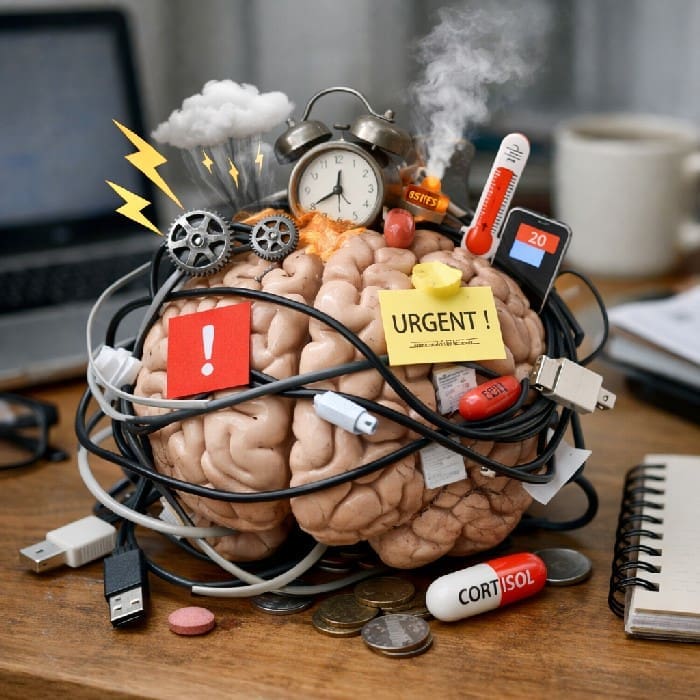
We are living in a time of stacked, chronic stress. Not one crisis followed by recovery, but a steady stream of pressure – financial concerns, job uncertainty, nonstop notifications, caretaking responsibilities, health worries, social tension, constant news cycles, and sleep disruption layered on top of it all. Individually these may not seem overwhelming, but together they keep the nervous system in continuous activation.
And here’s what matters: your brain interprets all of it as threat.
Your brain doesn’t distinguish between a physical danger and economic stress or email overload. When it senses an ongoing threat, it shifts from performance mode into survival mode.
Under chronic stress, your brain’s prefrontal cortex – the part responsible for focus, planning, motivation, and emotional regulation – becomes less efficient. That’s why organized adults suddenly feel scattered, procrastinate, and struggle to make simple decisions. At the same time, the brain’s amygdala becomes more reactive, increasing anxiety, irritability, and that constant “on edge” feeling. Additionally, the hippocampus, which supports memory, becomes sensitive to stress hormones, leading to word-finding difficulty and forgetfulness, symptoms that often scare people into thinking something more serious is wrong.

Stress is not just emotional. It is biological.
The good news is that the brain is adaptable. It shifted to protect you, and with the right support, it can shift back toward clarity and resilience.
Daily nervous system recovery, consistent sleep, reducing multitasking, real social connection, and physical brain support through movement and nutrition all make a meaningful difference. Small, steady changes help signal safety to the brain.
But we also believe something powerful happens when you can actually see how your brain is functioning.
At Be Well Solutions, we offer a complimentary QEEG Brain Map – a simple, non-invasive assessment that measures brainwave patterns and shows us how different regions are communicating. Instead of guessing, we can identify stress-driven overactivity, underperforming executive networks, and imbalances that may be contributing to fog, anxiety, or low motivation.
When we understand what’s happening, we can create a targeted plan to help your brain function better – not just temporarily cope, but truly improve.
If you’ve been thinking, “I don’t feel like myself,” that might be your brain asking for support.
You are not broken.
You might simply be overloaded – and we’re here to help you move forward with clarity.
Be Well Solutions and Complete Ketamine Solutions Destin |
www.CompleteKetamineSolutions.com | 850-786-2051