




































By Helen Petre
Our special part of the panhandle is famous for beaches, 30A, and dune lakes. While tourism makes up most of our economy, we benefit from state forests and parks which preserve our special environments. Part of that is our coastal dune lakes, all of which are threatened by coastal development and all that comes with it. Yet, some lakes are preserved by our land use choices.
Coastal dune lakes are permanent lakes that form inland of dunes. There are hundreds of dune lakes all over the world. Walton County has 19, or maybe 15, based on different classifications.
Walton County’s dune lakes are tannin-stained, which makes the water look brown due to organic matter in the lake. It does not negatively affect the water quality. Tannin means “crushed oak bark.” The tannin in the lakes is from the surrounding oak trees. Tannin is used for tanning animal skins.
Dune lakes are shallow (between 0.9 and 2.4 meters), and irregularly shaped. Most of our dune lakes have an intermittent connection with saltwater, or an outflow, which allows for water exchange, and results in an estuarine environment with a mixture of salt and fresh water, or brackish water. Some of our lakes have outflows that flow into other lakes, or storm water drainage ditches, or the outfalls do not exist because of alterations for development. Many of our lakes have outflows that flow through constructed tunnels under 30A. The lakes in our state parks retain their natural outflows. Each lake is different, and all are treasures to preserve.
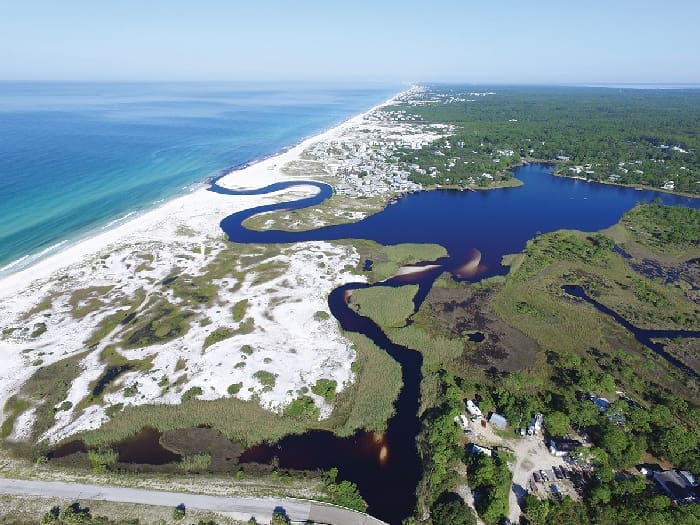
All of our lakes are fed by groundwater. Characteristics of lakes vary based on the size and shape of their basins, outflow channels, and the surrounding land use, but the water in the lakes always resembles ground water, because water tends to flow out of the lakes more than into them from the Gulf.
Groundwater levels are close to the ground surface, even during dry seasons. The sand and gravel aquifer brings ground water from high points in Alabama to our coast, so water tends to flow, only a few feet below the surface, from north to south, and empty into the Gulf, or close to it, in springs or dune lakes. The groundwater flow is unconfined and recharged from rainwater as well as river water from the north. Since ground water flows south, the lakes drain freshwater into the Gulf. Waves and tides, and especially storm events, can move saltwater into the lakes, but the water in the lakes still remains more characteristically fresh than salt.
Dune Lakes From East To West
Lake Powell is the largest and farthest east of our dune lakes. The outflow is in Bay County, while the lake is in both Walton and Bay Counties, at Camp Helen State Park. The outfall is open often, and it is amazing. Lake Powell is about a half a mile walk from the Camp Helen parking lot, either on a beach trail or through the woods.
Camp Creek Lake is surrounded by dense residential development and a golf course. The lake flows under 30A to connect to the Gulf. Access is limited except by walking along the beach or living in a community with access.
Deer Lake is part of Deer Lake State Park. A culvert passes under 30A connecting it to the Gulf.
Tresca Lake is the smallest dune lake. The outflow is permanently closed due to residential development, however, water overflows into Deer Lake.
Eastern Lake is on both sides of 30A and surrounded by residential and commercial development.
Western Northeast, Western, and Grayton Lakes are connected bodies of water. They have one outflow at Grayton Lake, which tends to open with high rainfall events. Western Lake is in Grayton Beach State Park.
Alligator Lake is on both sides of 30A, with a culvert connecting the two sides.
Little Redfish Lake and Big Redfish Lake are surrounded by dense residential development and are on both sides of 30A. Both have no public access other than walking along a beach.
Draper Lake is an elongated lake surrounded by dense residential development. There is no public access other than walking from a beach access.
Oyster Lake is surrounded by residential development. There is no public access. The outflow is under 30A.
Allen Lake overflows through a storm water ditch to Oyster Lake. Allen Lake is north of 30A. There is no public access.
Stallworth Lake is surrounded by residential development. There is no public access except to walk along the beach from Topsail.
Topsail Hill Preserve State Park
No Name Lake, Campbell Lake, and Morris Lake and are within Topsail Hill Preserve State Park, with its pine forests and freshwater wetlands. Lakes within Topsail Hill Preserve State Park are accessible only by foot, or tram within the park.
These three lakes are least impacted by development because they are in the park and require effort to reach.
Fuller Lake is on the western edge of Topsail Hill Preserve State Park and overflows into Morris Lake. Fuller Lake is inside the Coffen Nature Preserve. The only access is through the nature preserve.
Preserving our lakes
Most of our dune lakes are within residential communities. The people that live there surely want to keep the lakes pristine and natural, but it is difficult to develop land around water resources without altering them. Since the lakes naturally overflow into the Gulf, houses built around them must be built so they are not impacted by the outflow. People living in the communities must be conscious of the effects of fertilizer, pesticides and land use.
The lakes that are accessible to the public and are within our state parks are preserved and semi wild. Although many people walk to the outflows, especially at Camp Helen, they are often in awe, and unaware of what they are seeing. It is an ecosystem specially preserved for all of us, but a bit of a secret for those who know what it is. I am grateful that we have preserved these dune lakes, and not altered them, within our parks. When you visit the parks and see the outflows, remember what you are experiencing is something you most likely will not see anywhere else, and it is only due to the decisions we make about our land use and development that future generations can experience this.