









































By Helen Petre
I spend a lot of time doing things and interacting with organisms that people are terrified of. I walk in the woods alone. I look for spiders and snakes in roadside weeds. I kayak in alligator infested waters. I have even encountered a bear or two in the woods when I was hiking all by myself, miles from anywhere. I am not afraid.
I will die sometime, but not today, and not from walking in the woods, or drinking from a garden hose. For sure. Why are we so afraid? Why are we terrified of things that will not hurt us?
While it is true that you may die from a brain eating amoeba, a lightning strike, a plane crash, a venomous snake bite, or a meteor, you are more likely to die from things you are not afraid of, like a medical error, a dog bite, driving a car, or eating food. You will definitely not die of a spider bite.
We are all worried that we will die of covid, or some strange foreign pathogen, or a tick bite. Not so. Instead, the CDC estimates that 3,000 people die from food poisoning per year.
We are not frightened of eating, driving, or medical errors, but we are terrified of spiders and snakes, bats, insects, lightning, bears. We are terrified of things that kill virtually no one.
Spiders
Spider bites rarely cause death. In fact, the number of people that die from spider bites annually is an average of zero. People spray pesticides to kill spiders. The number of people who die from pesticide poisoning is 200,000 per year, as reported by the United Nations. Gosh. Maybe we should be a bit more afraid of pesticides than spiders.
Being afraid of spiders and snakes is learned. Our parents teach us this irrational fear. Maybe they should teach us to be afraid of other things, like eating, driving cars, and pesticides.
What do spiders kill?
Spiders kill things they can eat. You are too big. They are not interested. Spiders help you by eating insects. Spiders are food for birds, reptiles, and amphibians. Here are some spiders you may see. Do not be afraid.
Carolina wolf spiders (Hogna carolinensis)
In graduate school I did research with wolf spiders. Wolf spiders do not make webs. They are fast and hunt at night. We went out into corn fields at night with flashlights on our heads and plastic vials in bags tied to our belts. Empty vials in a bag tied to our belt on our right side. Full vials on the left. What fun. When we eye shined a spider, we moved in and captured it in a vial from the right side, and put the full vial in the bag on the left side.
Wolf spiders are solitary, hunt alone, and do not spin webs. They live in burrows. They have courtship displays in which the male taps his front legs and waves them in the air to impress the female. We studied this in the lab. What a great college experience. As is usual for insects, the males die after mating. The females live for years.
After successful mating, the female carries her egg sac. When the hatchlings are born, they ride on the mother’s abdomen for several weeks. She is a great mom.
Wolf spiders are beneficial. They eat crickets, grasshoppers, beetles, cockroaches, and ants. They do not bite. I held many in my hands and none of them bit me.

Garden spider (Argiope aurantia)
Male garden spiders are about one quarter of an inch, but their female mates are more than one inch. Females build webs in open, sunny places and stay there. If you have a garden spider in your yard you can watch her all summer feasting on all those insects that you are terrified of. The web is circular, about two feet in diameter, with a characteristic zig zag of silk, the stabilimentum, in the center. No one knows what it is there for. The spider can oscillate her web vigorously and stay attached in the center. No one knows why she does this, either. The male builds a smaller web nearby.
The garden spider keeps a neat web. She is not aggressive and does not attack large animals, like you. She sits in her web all day waiting for insects to get caught. She likes mosquitos, grasshoppers, flies, and aphids.
Garden spiders mate twice a year. The male goes to the female’s web and carefully tries to attract her, while keeping a safety drop line available, just in case she tries to eat him. If the female likes him, they mate. He transfers sperm to her using his front legs. He does this twice. Then he dies. Then she eats him.
She lays her eggs, wraps them in a silk ball about one inch in diameter and puts it near her web. Each egg sac has about 1,000 eggs. She makes about four. In the spring, the spiderlings hatch.
Golden silk orb weavers (Trichonephila clavipes)
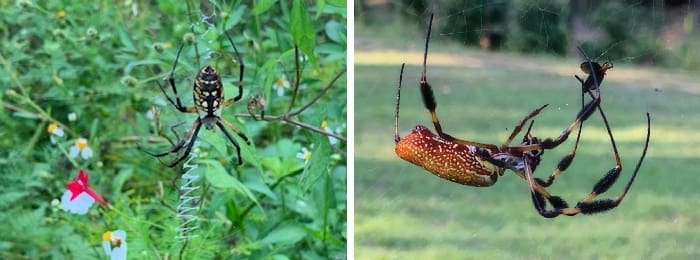
If you walk trails, you might encounter a female golden silk orb weaver. She builds her web across trails, and while it is creepy to walk into webs, it is not going to hurt you. Like other web building spiders, golden orb weavers spend a lot of time sitting there waiting for insects to fly into the web. Look closely at the web and you will see her mate, a much smaller male, trying to hide from her. He has more to worry about than you do.
Golden orb weavers are usually found in clusters, so if you find one on the trail, it is a good idea to pay attention. Orb weavers make a new web each evening and are active at night.
These are just a few of the spiders you may encounter out there in the weeds, trails, and your backyard. Spiders will not hurt you. They are your friends. They eat insects and are eaten by things you like, such as birds. Fear of things that do not hurt you is learned. Spend some time outside and unlearn the fear.
Helen Petre is a retired biologist enjoying life among the wild things of the Florida Panhandle. The pictures were taken by Abigail Petre, an 11-year-old who never learned to be afraid. If you have suggestions or ideas about science or wild things, email petrehelen@gmail.com.